Why a Hardwood Floor Can Outlive Almost Everything Else in Your Home
Walk into a house built in 1920 and there is a decent chance the floor under your feet is original. The kitchen has been gutted twice, the roof has been replaced, the furnace is on its third incarnation, yet the oak boards are still doing their job. That kind of longevity isn’t luck. It comes down to how wood is built at the cellular level and how a floor is put together on top of it.
Wood is engineered by trees, not factories
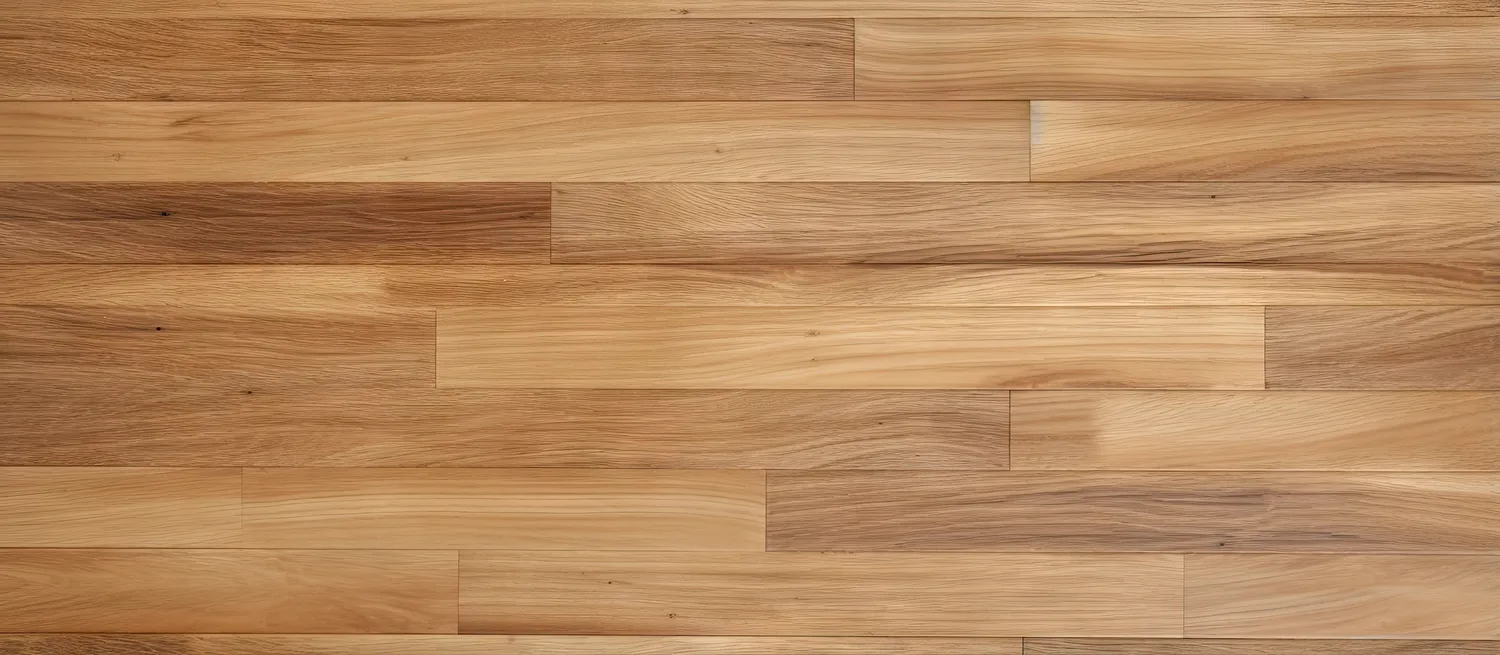
A single oak board is made of millions of tiny hollow tubes running lengthwise, each one once used by the living tree to move water from roots to leaves. When the wood is dried, those tubes become a dense bundle of fibers that resist crushing along the grain surprisingly well. White oak, the most common flooring species in the Midwest, rates around 1,360 on the Janka hardness scale, which measures the force needed to push a steel ball halfway into the surface. Hickory sits near 1,820, and Brazilian walnut exceeds 3,600. For comparison, a typical pine board comes in under 700.
That hardness is why hardwood shrugs off decades of chair legs, dog nails and dropped pans. The finish takes the hit first; the wood underneath rarely does.
The hidden detail: thickness is a renewable resource
Here’s the fact most homeowners miss. A standard solid hardwood plank is three-quarters of an inch thick, but only the top quarter inch or so sits above the tongue-and-groove joint. That upper layer is the floor’s “sanding budget.” Each full refinishing removes roughly a thirty-second to a sixteenth of an inch, which means a solid floor can typically be sanded back to bare wood five to seven times over its life.
Do the math on a floor refinished every fifteen to twenty years and you’re looking at a century or more of service from a single installation. Few other building materials can claim that. Carpet is usually tired by year ten. Laminate can’t be sanded at all; once the wear layer is scratched through, the board is finished.
This is the reasoning behind a search that people type thousands of times a year: hardwood floor installation near me Arlington Heights. The initial cost is higher than most alternatives, but it’s a one-time cost spread over generations rather than a recurring one.
Why old floors sometimes look better than new ones
Wood changes color as it ages. Ultraviolet light slowly breaks down lignin, the natural polymer that binds wood fibers, and the result is a gradual warming of tone. Cherry darkens dramatically; oak mellows into a deeper amber; walnut actually lightens slightly. This is why a rug moved after ten years leaves a pale “shadow” on the floor, and why antique floors have a depth of color that stain alone struggles to copy.
Older floors also tend to be made from slower-grown timber with tighter growth rings. A board with twenty rings per inch is denser and more stable than one with six. That’s part of why reclaimed flooring from old barns and factories commands premium prices.
Moisture is the only real enemy
If hardwood has a weakness, it’s water. Wood is hygroscopic, meaning it constantly exchanges moisture with the air around it. A board that is comfortable at 35 to 55 percent relative humidity will swell when a basement floods or shrink when a furnace runs dry for months. Most “failed” hardwood floors didn’t wear out; they cupped, buckled or gapped because of a humidity problem in the house.
The practical takeaway is that the floor and the home’s climate are a system. Keep indoor humidity in a reasonable range and the floor will more or less take care of itself.
Finishes have quietly improved
The lacquers and shellacs used on floors a century ago needed re-coating every few years. Modern water-based polyurethanes cure harder, yellow less and dry in hours instead of days. Penetrating hardwax oils, popular in Scandinavia for decades, have also made their way into American homes; they sit in the wood rather than on it, which makes spot repairs possible without sanding an entire room.
These developments mean that anyone looking up hardwood floor installation near me Arlington Heights today is getting a floor that will likely need less maintenance than the one their grandparents had, while keeping the same underlying wood that made those older floors last.
The bottom line
A hardwood floor is less a product than a long-term relationship with a natural material. It will move with the seasons, change color with the light and show the history of the house in its grain. Treat it well, refinish it when it’s due, and there’s a good chance it will still be there when the next owner walks through the door.